
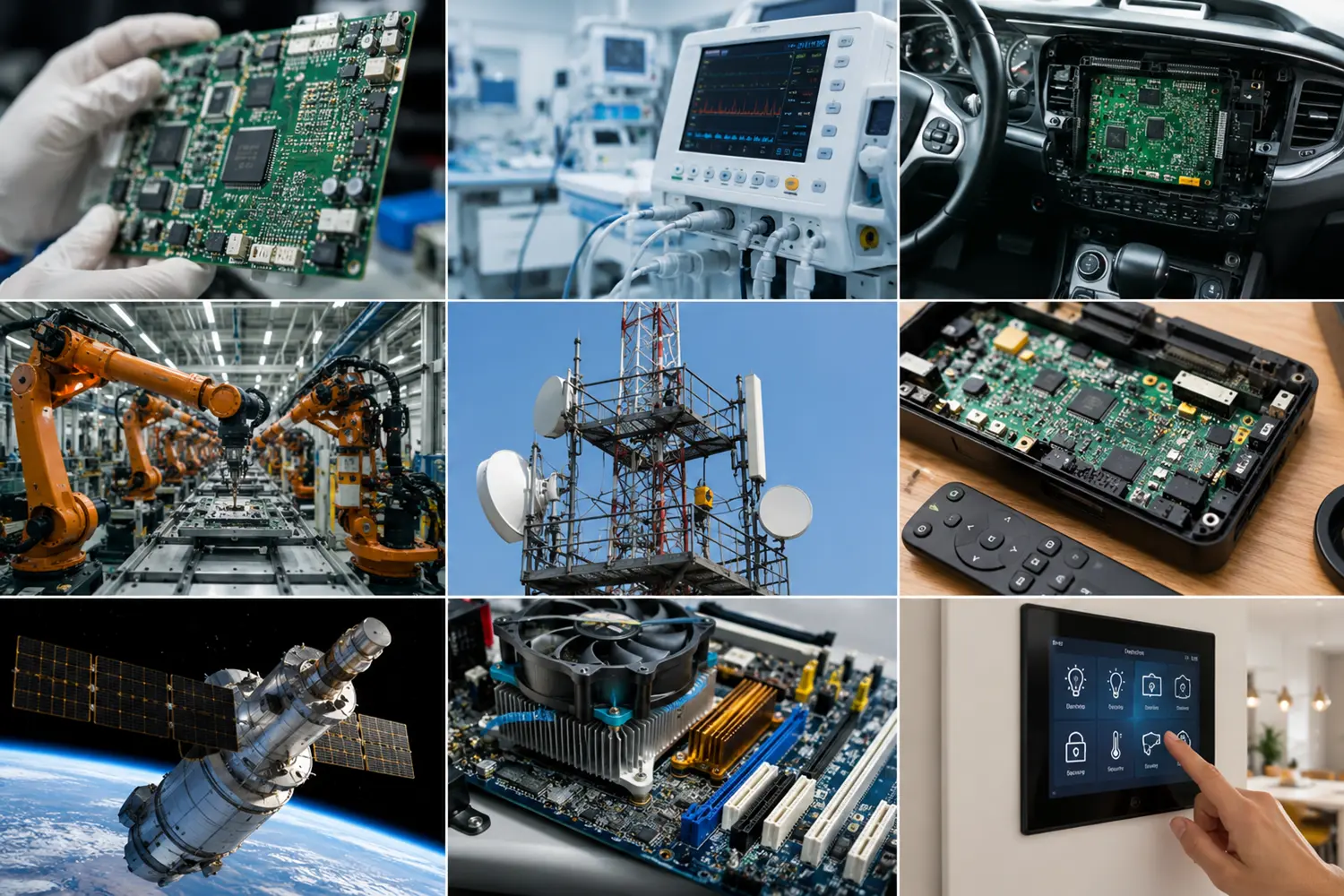
Printed circuit boards are everywhere. If you can name an electronic device — any device — there's almost certainly at least one PCB inside it, quietly routing signals, distributing power, and connecting components into a coherent system. The global PCB market, valued at over $80 billion, touches virtually every sector of the modern economy. But where exactly are circuit boards used, and what makes each application unique?
In this comprehensive guide, the AEAR team maps out every major industry that depends on PCB technology — examining the specific requirements, standards, and design challenges that define each sector. Whether you're an engineer specifying boards for a new product, a procurement professional sourcing PCBs, or simply curious about the technology that powers the modern world, this article provides the complete picture.
Consumer Electronics
Smartphones, laptops, TVs, gaming consoles, wearables
Medical Devices
Pacemakers, MRI, patient monitors, diagnostic equipment
Automotive
ECUs, infotainment, ADAS, EV battery management
Defence & Military
Radar, missile guidance, secure comms, ruggedized systems
Aerospace
Avionics, satellites, flight control, navigation systems
Industrial Automation
PLCs, motor drives, sensors, robotics controllers
Telecommunications
5G base stations, routers, optical networking, antennas
IoT & Smart Home
Smart thermostats, sensors, connected appliances
1. Consumer Electronics
Consumer electronics is by far the largest market for PCBs by volume. Every smartphone contains multiple multilayer HDI (High-Density Interconnect) PCBs with microscopic trace widths, laser-drilled microvias, and dozens of layers packed into a package just a few millimetres thick. The relentless drive for thinner, lighter, more powerful devices pushes PCB technology to its limits — today's flagship smartphones use any-layer HDI and mSAP (modified Semi-Additive Process) techniques to achieve trace/space dimensions below 30/30 µm.
Laptops, tablets, televisions, gaming consoles (PlayStation, Xbox, Nintendo Switch), smartwatches, Bluetooth earbuds — every one of these products relies on custom-designed PCBs. The consumer electronics sector demands high volumes, aggressive cost optimization, rapid design cycles (often 6-9 months from concept to market), and increasingly, flex and rigid-flex PCBs to fit into curved and compact enclosures.
2. Medical & Healthcare Devices
The medical electronics sector is one of the most demanding for PCB reliability. When a circuit board powers a pacemaker, an infusion pump, or a surgical robot, failure is simply not an option. Medical PCBs must meet stringent standards including IPC Class 3 for high-reliability electronics, ISO 13485 for medical device quality management, and IEC 60601 for electrical safety.
Applications span the full spectrum: implantable devices (pacemakers, neurostimulators, cochlear implants) require ultra-miniaturized, biocompatible flex PCBs; diagnostic imaging (MRI, CT, ultrasound) demands low-noise analog front-ends and high-speed digital processing; patient monitoring systems need robust wireless connectivity; and laboratory equipment requires precision analog measurement circuits with extremely low drift.
Key Insight
The global medical PCB market is projected to grow at a CAGR of 5.8% through 2030, driven by an aging population, increasing prevalence of chronic diseases, and the rapid adoption of wearable health monitors and telemedicine platforms.
3. Automotive & Electric Vehicles
Modern vehicles contain anywhere from 50 to over 150 individual PCBs, and that number is growing rapidly with the transition to electric vehicles (EVs) and advanced driver-assistance systems (ADAS). The automotive environment is uniquely harsh: extreme temperature ranges (−40°C to +125°C or higher in engine compartments), continuous vibration, exposure to moisture, chemicals, and salt spray, and a required service life of 15+ years.
Key automotive PCB applications include: Engine Control Units (ECUs) using heavy copper (4-10 oz) for high-current ignition and fuel injection drivers; Battery Management Systems (BMS) in EVs that monitor individual cell voltages and temperatures across hundreds of series-connected cells; ADAS sensor modules (radar, LiDAR, cameras) with high-frequency RF materials (Rogers, Taconic) for 24 GHz and 77 GHz operation; and infotainment systems with high-layer-count HDI boards. Automotive PCBs must comply with AEC-Q100, IATF 16949, and IPC-6012DA automotive addendum standards.
4. Defence & Military Systems
Defence electronics represent the pinnacle of PCB reliability and performance requirements. Military PCBs must function flawlessly in the most extreme conditions imaginable — from the freezing vacuum of high-altitude reconnaissance to the intense shock and vibration of an artillery-fired guided munition. Specifications are governed by MIL-PRF-31032, MIL-PRF-55110, and MIL-STD-810 for environmental testing.
Applications include: radar and electronic warfare systems using specialized low-loss RF laminates with tight dielectric constant control; secure communication equipment with embedded encryption and TEMPEST shielding; missile guidance and avionics requiring IPC Class 3/A (space and military avionics — the highest classification); ruggedized field computers with conformal coating for moisture and fungus resistance; and unmanned systems (drones, UGVs, UUVs) where SWaP (Size, Weight, and Power) optimization is critical.
5. Aerospace & Avionics
Aerospace PCBs share many requirements with defence electronics but add the unique challenges of the space environment: outgassing (materials must meet NASA/ESA low-outgassing standards per ASTM E595), radiation tolerance (total ionizing dose and single-event effects), extreme thermal cycling (−65°C to +150°C in Low Earth Orbit), and zero margin for in-flight repair.
Satellite PCBs often use polyimide (rather than standard FR-4) for its superior thermal stability and lower outgassing. Thermally conductive substrates help dissipate heat in the vacuum of space where convection cooling doesn't exist. Avionics systems — flight control computers, navigation systems, engine monitoring, cabin pressurization — must be certified to DO-254 (design assurance) and DO-160 (environmental qualification) standards enforced by aviation authorities worldwide.
6. Industrial Automation & Robotics
Industrial environments subject PCBs to dust, humidity, chemical exposure, temperature extremes, continuous 24/7 operation, and electrical noise from heavy machinery. Industrial PCBs must be robust, often using heavier copper weights (2-6 oz) for high-current motor drives, wider clearances for high-voltage isolation (up to several kV), and conformal coating for environmental protection.
Key applications: Programmable Logic Controllers (PLCs) — the brains of factory automation; variable frequency drives (VFDs) for motor speed control with IGBT power stages; industrial sensors (temperature, pressure, flow, proximity, vision); robotic motion controllers requiring real-time multi-axis coordination; and Human-Machine Interfaces (HMIs) with touchscreen displays for operator interaction. The rise of Industry 4.0 and the Industrial Internet of Things (IIoT) is driving demand for PCBs with integrated wireless connectivity (Wi-Fi 6, 5G, LoRaWAN) and edge computing capabilities.
7. Telecommunications & Networking
The telecommunications infrastructure that powers global internet connectivity — from undersea fibre optic cables to 5G cellular towers — depends entirely on high-performance PCBs. The rollout of 5G networks has created enormous demand for PCBs capable of handling mmWave frequencies (24-100 GHz), requiring ultra-low-loss materials like PTFE-based laminates, ceramic-filled hydrocarbon, and liquid crystal polymer (LCP).
Data centres — the physical backbone of cloud computing — contain thousands of server motherboards, each with high-layer-count PCBs (20-40+ layers) supporting multi-gigabit serial links (PCIe Gen5/6, 100G/400G Ethernet). Backplane PCBs in networking equipment can be over 60 cm long with thousands of differential pairs, requiring exacting impedance control (±5% or better) across the entire length.
8. IoT & Smart Devices
The Internet of Things (IoT) represents one of the fastest-growing PCB application spaces. By 2030, there will be an estimated 30+ billion connected IoT devices worldwide. IoT PCBs are characterized by their diversity — from tiny sensor nodes powered by coin cells that must operate for years on a single charge, to smart home hubs with voice recognition and AI processing.
Key design considerations for IoT PCBs include: ultra-low power design (nA-range sleep currents, efficient DC-DC converters), integrated wireless (BLE, Zigbee, Thread, Matter, Wi-Fi, NB-IoT, LoRa), miniaturization (flex and rigid-flex to fit into compact form factors), sensor integration (MEMS accelerometers, environmental sensors, biosensors on the same PCB), and security (hardware root of trust, secure element ICs). The Matter smart home standard is driving a new wave of interoperable IoT devices, all requiring Matter-certified PCB designs.
9. Conclusion & Industry Outlook
Printed circuit boards are the universal platform upon which modern electronics are built. From the simplest single-sided board in a toy to the most complex 40-layer backplane in a telecommunications switch, PCBs are the essential interconnect technology that makes electronic functionality possible.
The trends shaping PCB applications across industries point clearly in one direction: more complexity, higher performance, and greater reliability demands. The convergence of 5G, AI at the edge, autonomous vehicles, wearable health tech, and Industry 4.0 is creating unprecedented requirements for PCB technology — and manufacturers like AEAR are at the forefront, delivering high-reliability PCBs that meet the most demanding specifications across every sector.
Why Choose AEAR for Your Industry-Specific PCBs?
AEAR provides end-to-end PCB solutions tailored to your industry — whether you need MIL-SPEC boards for defence, IPC Class 3 for medical, IATF 16949-compliant automotive PCBs, or high-frequency RF boards for 5G telecommunications. Our manufacturing facility is equipped for rapid prototyping through high-volume production, with full testing, inspection (AOI, X-ray), and certification support.
Amit Patel
This is the most comprehensive PCB applications guide I've come across. The industry-by-industry breakdown really helps understand the different requirements. I design automotive PCBs and the section on AEC-Q100 and IATF 16949 was spot on.
Lisa Reynolds
Great overview of aerospace PCB requirements. I'd add that for LEO satellites, atomic oxygen erosion is another factor — silver-plated traces can degrade unless protected. Polyimide with conformal coating is the way to go.